Photocatalytic Antibacterial Coatings - BYC Group Glass Processing and Coating
Main menu:
Coatings
Single Fired Anti-Bacterial Coatings
that Show Photocatalytic Activity within the Visible Range
Photocatalytic activity was first
observed in TiO2 particles when their role in water hydrolysis was
discovered. Photocatalytic materials also exhibit strong antibacterial effects
that are triggered by light exposure. Conventionally, photocatalytic properties
of nanoparticles that are incorporated in a coating precursor are activated by
UV radiation. However, sun is a much better visible light emitter than it is a
UV emitter so it is desirable to have photo-catalyst materials to be used in outdoor
applications for better efficiency under sunlight. Additionally, UV light
sources, artificial or not, pose a great threat to human health by promoting
skin cancer.
BYC United offers a new material solution whose
photocatalytic activity is shifted towards the visible radiation range thanks
to its band-gap engineered nanoparticle content. The new coating is optically
transparent and does not lead to any coloration of the substrate surface. The
application involves spray coating at 80-100 oC and it does not
entail an additional heat treatment step.
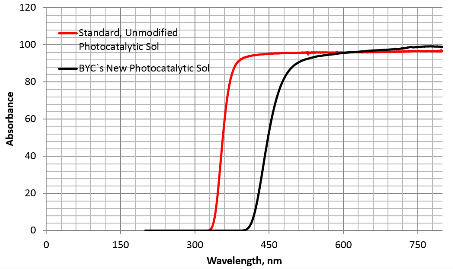
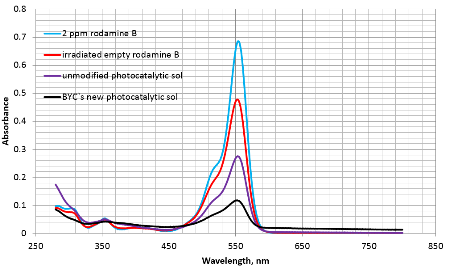
Light transmission spectra shows that BYC`s new generation photocatalytic coating possess strong absorbance character in the visible portion (350-750nm) of the EM spectrum, and unlike a conventional coating it does not absorb in the UV range (100-400nm). Alternatively tests with Rodamin B pigment under a sun simulator shows that its absorbance reduces
most significantly for samples that contains the new material.
Optionally photocatalytic coatings from BYC United can be
ordered with antibacterial additives. The customers are offered with several
alternatives (depending on the application, a combination of them can be used
for wide spectrum effect, please inquire) as antibacterial additives;
·
Benzalkonium chloride (rated as class III
antiseptic by FDA)
· Copper
and its alloys
· Silver
· OmadineTM
and related compounds (EPA and FDA approved)
The addition of antibacterial agents as tested on gram
negative Escherichia coli (E. coli)
and gram positive Staphylococcus aureus
(S. aureus) bacteria, leads to >%99.9 decrease in population for each
case.